Inhalt anzeigen
Quellen
Häufige Fragen
Passende Leistung
 Leistung
Auch auf LinkedIn diskutiert: Beitrag ansehen

·
Kurzantwort
Leistung
Auch auf LinkedIn diskutiert: Beitrag ansehen
Kontakt
Sprechen Sie direkt mit der verantwortlichen Person für dieses Thema. Wir melden uns innerhalb eines Werktags.
Kontakt aufnehmen →+49 234 58885-0Safety-I defines safety as a state in which as few things as possible go wrong and learns mainly from accidents. Safety-II defines safety as the ability to succeed under varying conditions and also learns from everyday work that goes right. Both approaches complement each other. SAFETEE combines them on projects with Learning Teams and structured deviation analysis.

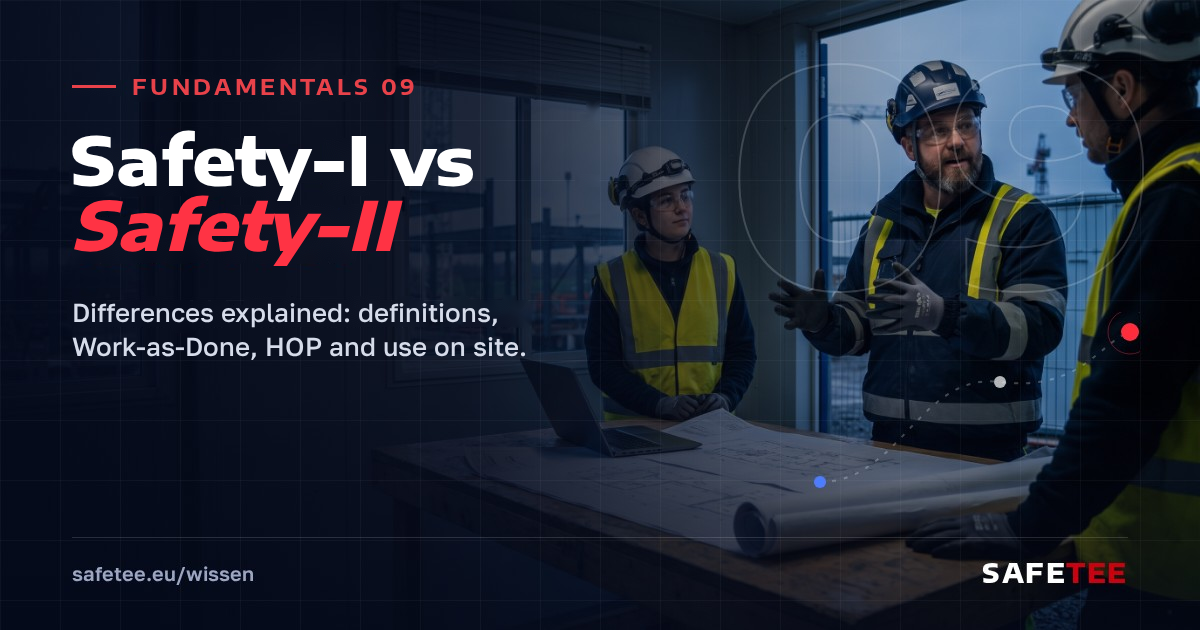
Safety-I sees safety as a state in which as few things as possible go wrong. It is reactive: it responds when something has happened and looks for causes and deviations. Safety-II sees safety as a system’s ability to succeed under varying conditions, so that as many things as possible go right. It is proactive and also learns from normal, successful work. (EUROCONTROL White Paper 2013; retrieved 30.09.2026)
Comparison: Safety-I vs Safety-II at a glance
Source for the first five rows: Table 1 of the EUROCONTROL White Paper “From Safety-I to Safety-II” (2013). The last row reflects our project practice.
The terms were shaped by the safety researcher Erik Hollnagel. They became widely known through the EUROCONTROL White Paper “From Safety-I to Safety-II” by Hollnagel, Leonhardt, Licu and Shorrock, published in September 2013, and Hollnagel’s book “Safety-I and Safety-II” from 2014. Both originate in air traffic management and are now used in industry, healthcare and construction. (EUROCONTROL 2013, Hollnagel 2014; retrieved 30.09.2026)
Safety-II does not replace Safety-I. Legal duties, risk assessments and incident investigations remain necessary. Safety-II adds the question of why work usually succeeds, even though conditions are rarely exactly as planned.
Work-as-Imagined is work as described in plans, procedures and risk assessments. Work-as-Done is work as it actually happens: under time pressure, with missing material, in wind and with changing crews. A gap between the two is normal. It becomes dangerous when nobody knows about it. Safety-II makes this gap visible and uses it for better planning. (EUROCONTROL White Paper 2013; retrieved 30.09.2026)
On a construction site this can look like this: the installation instruction specifies an anchor point that another trade has already built over. The crew finds a workaround that works. Safety-II asks what that workaround looks like, whether it is safe and what the planning can learn from it.
HOP stands for Human and Organizational Performance. It has roots in the human performance movement of the US nuclear industry and shares the Safety-II view that people are part of the solution. Its core principles: people make mistakes, blame fixes nothing, context drives behaviour, learning is vital and how leaders respond to failure matters. (DOE-HDBK-1028-2009, Safety Differently; retrieved 30.09.2026)
In practice, HOP turns the question after an event around: not “Who was to blame?” but “What made this error possible and likely?” Learning Teams, moderated conversations between those who do the work and those who plan it, are the most common tool.
Yes. The main debate is about how Safety-II can be measured and put into practice in daily operations; publications from healthcare, for example, describe this difficulty. Critics of HOP point out that it is sometimes wrongly presented as the opposite of Behaviour Based Safety. We are not aware of independent effectiveness studies on HOP as a complete concept. (PubMed 2022, Aubrey Daniels International; retrieved 30.09.2026)
Our conclusion: we use the approaches as tools, not as a belief system. Which method fits depends on the operation, the risk and the maturity of the organisation.
Small steps work best. Supervisors ask during site walks what is different from the plan today and why. After an event, a Learning Team is held in addition to the cause analysis. Deviations are classified fairly: did the person not know, not have the ability, not have permission or not want to? The right consequence follows from the answer. (SAFETEE practice; as of 30.09.2026)
Safety-II is no invitation to ignore rules. The aim is rules that fit the real work, developed together with the people who do it. An overview of all approaches is available on our page Safety methods.
We introduce Safety-II and HOP elements where they are effective: moderating Learning Teams, training supervisors to talk about Work-as-Done, investigating events with a focus on conditions and combining this with BBS and classic tools. Our consulting offer is described under Safety Consulting. You can reach us via our contact page. This article is also available in German.
No. Safety-II complements Safety-I. Investigating accidents, following rules and assessing risks remain necessary. Safety-II adds a view of everyday work: why does work usually succeed although conditions keep changing? Organisations that combine both learn from accidents and from what goes well every day.
It means paying attention to normal, successful work and not only to failures. Supervisors ask how crews cope with changing conditions, which workarounds they use and what makes the job easier or harder. These answers improve planning, material supply and procedures before something goes wrong.
A Learning Team is a moderated conversation between the people who do the work and those who plan or are responsible for it, held after an event or in advance of new work. In our experience a first session takes one to two hours. Neutral moderation and binding feedback on the results are decisive.
BBS focuses on observable behaviour and reinforces safe behaviour through observation and feedback. HOP focuses on the conditions in which behaviour arises and asks how systems can catch errors. The approaches complement each other when BBS observations are used as a starting point to improve working conditions.
No. Rules remain important. Safety-II asks whether rules fit the real work. If crews regularly have to bypass a rule to get their job done, that points to a problem in planning or in the rule, not only in the crew. The answer is a better rule, not a missing one.
With conversations. During site walks, supervisors ask what is different from the plan today and how the crew handles it. After the next event, a Learning Team is moderated. Both lead to concrete improvements. That way Safety-II becomes visible in daily work without a large programme.